
Enrichment drafts cited library proposals from documents, context gaps, and member suggestions, and serves nothing until a steward approves it.
Learning and enrichment
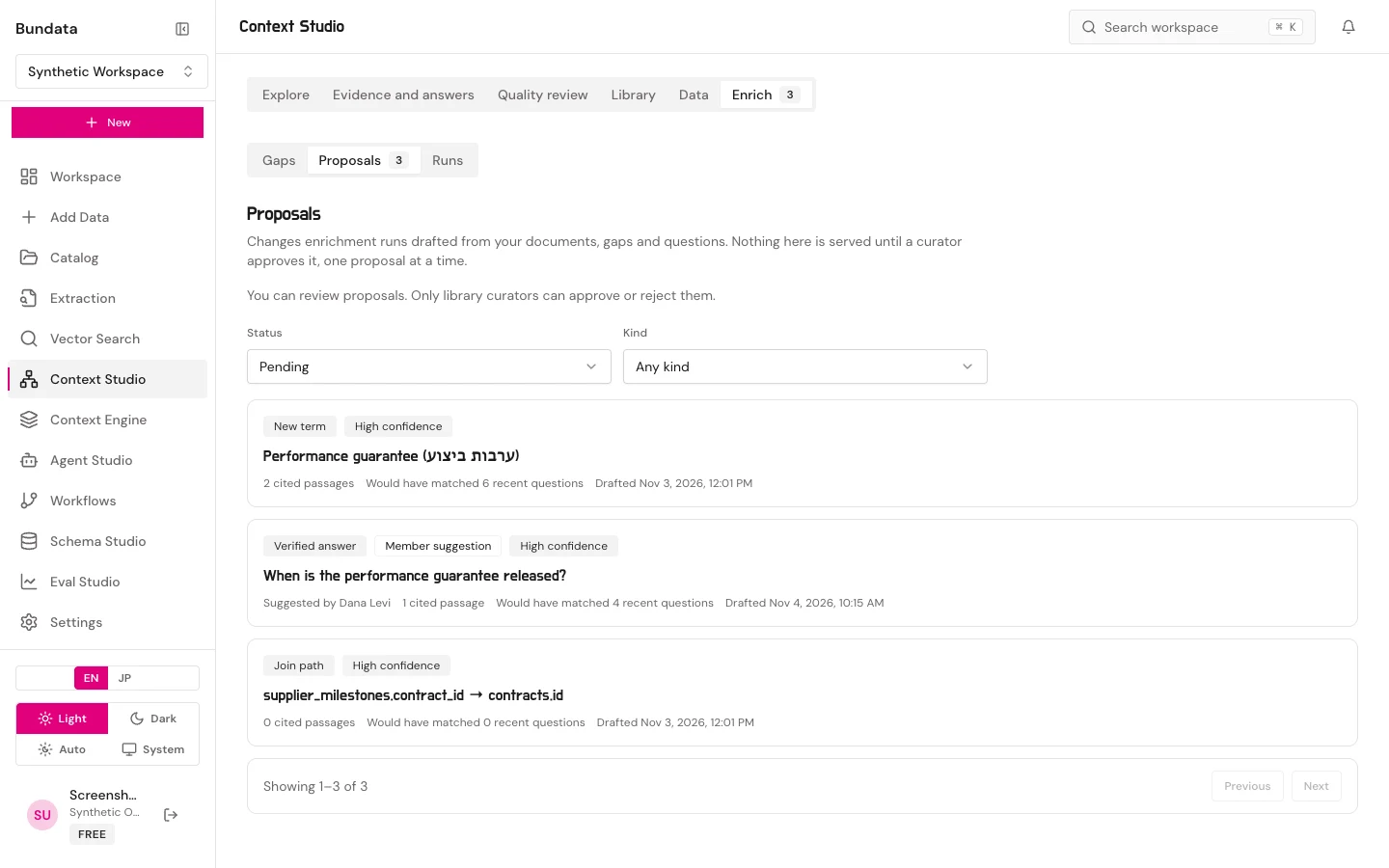
Context Studio → Enrich (/platform/context-graph?view=enrich) combines two governed loops that help curators grow the business context library:
- Learning from questions and Gaps (
&enrich=gaps): Finds missing definitions, ambiguous names, and recurring unanswered questions from answer feedback and opt-in outcome records. - Proposals and Runs (
&enrich=proposals,&enrich=runs): Drafts cited library proposals from documents, open gaps, and member suggestions for one-click steward review.
Answer feedback and Settings → Learning
Every answer surface (Collection Ask, Vector Search knowledge chat, header search, and Lineage questions) includes Helpful and Not helpful feedback controls.
In Settings → Learning (/platform/settings?tab=learning), the workspace owner (learning:manage) chooses what Bundata keeps beyond explicit feedback:
| Level | What is stored | Retention |
|---|---|---|
| Off (default) | Nothing except feedback a member chooses to send | Feedback stays until deleted by the member |
| Outcomes only | Content-free records (surface, coverage status, claim-check and citation counts, latency, tokens, and a keyed hash of the question) | 7 to 90 days (default 30) |
| Outcomes and redacted question text | Outcome records plus question text after deterministic PII redaction ([email], [phone], [ID number], [card number], [bank account], [number]) | 7 to 90 days (default 30) |
Shortening retention, switching from text to outcomes only, or turning learning off immediately purges data that the new setting no longer allows. Members can view and delete their own kept questions and feedback at any time under Settings → Learning → Your data.
The Gaps list
The gap finder runs daily and on demand (Find gaps now, once per 10 minutes for curators) to identify eight gap types: Undefined term (feedback or agent report_context_gap), Ambiguous term, Not enough evidence, Negative feedback, Rephrased questions, Outdated sources, Frequent question with no verified answer, and Slow or expensive topics. Gaps automatically resolve when an approved library entry covers the topic and signals drop by at least half over 14 days.
Enrichment runs and proposal kinds
Curators configure enrichment under Enrich → Runs → Settings (PUT /api/w/:wsId/context-enrichment/settings): collection scope (1 to 50 collections), schedule (off, daily, weekly), automatic trigger on document changes, model choice, and token budget per run (5,000 to 5,000,000, default 200,000).
An enrichment run drafts proposals that always cite exact document passages (never AI-written summaries):
- New term, Term update, Verified answer, Instruction, Link (to a graph entity or ontology type), Retirement, and Conflict (when two sources disagree).
- Data description, Term to data link, and Join path for structured database and dbt objects (drafted without calling a model).
Member suggestions and one-click review
From the Answer workspace or saved Ask history, any member who can read the cited documents can click Suggest for organization memory to submit a whole answer (as a verified answer) or a selected span (as a business term or instruction). Reviewers see only the suggested wording, question, and citations—never the member’s private conversation or notes.
In the Proposals inbox, stewards review each drafted proposal or member suggestion one by one (no bulk approval):
- Approve with a reason chip or typed reason, Edit then approve, or Reject with a reason.
- Check changes: When an evaluation dataset is attached to the library, curators can test selected pending proposals against the dataset before deciding. Approving a proposal whose check found an accuracy regression requires an
overrideReason(409 REGRESSION_OVERRIDE_REQUIRED).