
Search and Answer are two modes on the collection Search tab, powered by Hybrid Retrieval v2, structured briefs, table facts, and governed memory.
Search and answer
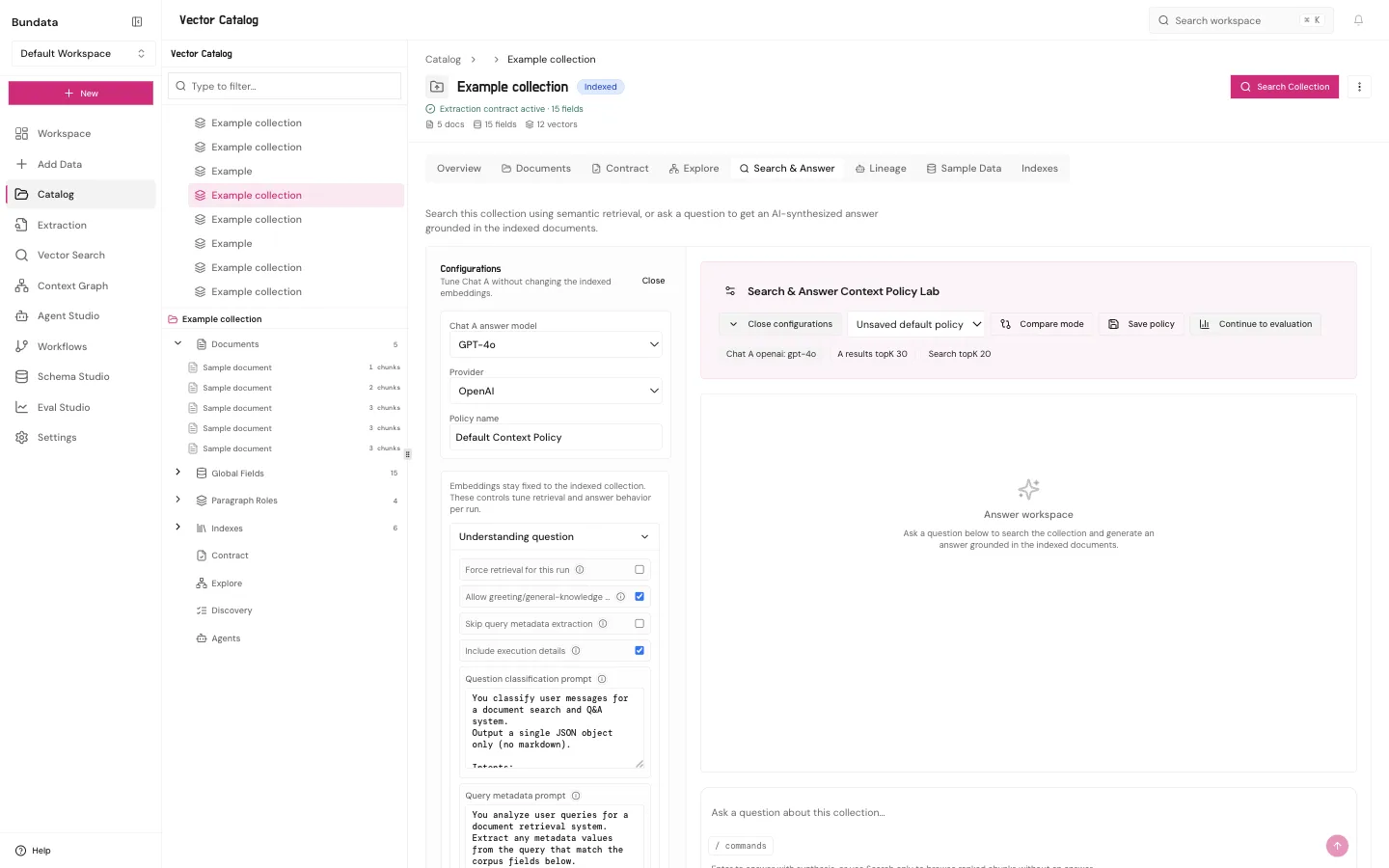
Search and Answer are two modes on the collection Search tab (POST /api/collections/:id/retrieve, /answer, and /answer/stream). They do not use the same topK.
Search only and Hybrid Retrieval v2
Search only returns ranked chunks up to Search results topK without writing an answer. Collection retrieval uses Hybrid Retrieval v2, which fuses in parallel:
- Dense vectors: PostgreSQL-native
pgvectorexact scans (up to 20,000 rows or 500 scoped documents) or HNSW with iterative scans (hnsw.iterative_scan = relaxed_order), never mixing embedding models. - Lexical BM25: Shared Hebrew/English analyzer with Hebrew prefix trimming, plus vocabulary rules automatically enabled on discovered collections.
- Section lookup and multi-size chunks: Named clauses, chapters, or appendices lead the returned order through the document section map (
topology), and extra chunk sizes (500 / 1,500 / 4,500) project hits onto main Smart Bites with focus-centered excerpts.
If the overview model fails during search enrichment, Bundata logs the error code and still returns the retrieved passages rather than showing an empty result.
Answer and the structured brief
Answer retrieves up to Answer results topK ranked chunks, then writes a grounded reply in the language of your question (question-language/v1, with automatic RTL/LTR layout and <bdi> isolation for numbers, dates, and codes) formatted as a structured brief (answer-brief/v1):
- Answer: Direct answer with at least one exact short quote and
[N]citations after every claim. - Prevailing position: Whether the documents settle the governing rule (
settled: true | false). - Direct support and Supporting context: Cited points and word-for-word verified quotes from the passages.
- The other side: Exceptions, limits, or conflicting passages (
[]when none exist). - Gaps: Parts of the question the passages do not answer.
Every quoted span is checked word for word against the canonical passage text, and deterministic claim verification (claim-verification/v5, plus streaming claim repair when BUNDATA_CLAIM_REPAIR is enabled) applies the workspace’s remove, caveat, or abstain policy.
When enabled in Context Engine, answers also draw on:
- Studied field answers (
field_answers_v1): List, count, rank, filter, and compare questions are answered deterministically from normalized extracted field values (answerMode: "field_answer"), with a[n]span citation on every cited value, field coverage lines, and a “May be incomplete” notice whenever a field is stated in fewer than 90% of documents. - Table facts (
tables-v3): Numeric and bill-of-quantities questions include cell facts ([TF1]) andfinancerule arithmetic reconciliation findings ([RF1]). - GraphRAG paths (
local,multi_hop,temporal,global): Typed-fact theme digests and multi-hop graph evidence.
Ask history and Organization memory
In stored workspaces, the Answer workspace includes two memory surfaces:
- History and What Bundata remembers (
ask-history): Saves each member’s private conversations in the collection (nobody else, including workspace owners, can read them). Follow-up questions are rewritten into standalone search queries, and new questions can recall up to 3 relevant earlier turns (by word overlap or fused BM25 + meaning + entity ranking, and optionally across collections when the owner enables Recall across collections). Members can also keep up to 20 standing notes per collection and inspect or delete their Agent memories. - Organization memory: Uses approved Business context library definitions (
[DP1]) and instructions, shows the Asked before card while typing when an approved verified answer matches, serves verified answers (answerMode: "verified_answer"), and lets members click Suggest for organization memory on any cited answer or selected text.
What this does not do
Search does not change the collection’s embedding profile. A missing provider key, a chosen model whose provider is disconnected, or a role without agent:run blocks Answer. Non-retaining workspaces keep no Ask history, notes, or organization memory.