
A feature list is not a second product edition. Bundata has one product, with roles and workspace modes.
Orientation
Use this page to place the words you will meet in the recipes. Reading time is about 15 minutes. It does not start a run.
Purpose
You can name the object a later step reads or writes. Level: reader who finished What Bundata is. Role: any role that can open the workspace. Mode: stored, unless a step says non-retaining.
Pieces
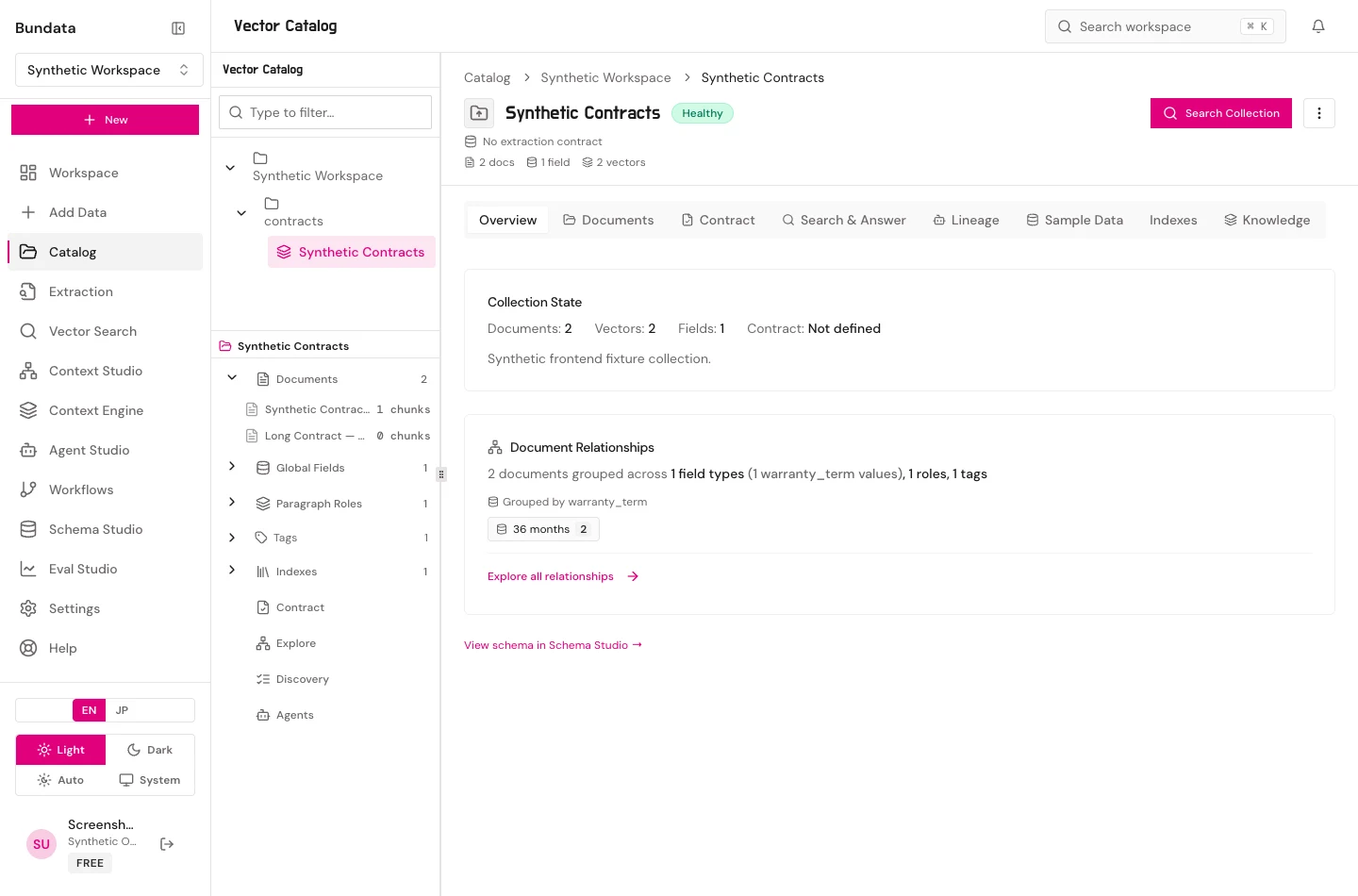
A schema is the approved field contract. A document is a file in a collection. A Smart Bite is a stored passage with its own id (with optional extra chunk sizes derived from it). A collection holds documents, bites, vectors, and studied field values. Search returns bites, a structured answer brief (answer-brief/v1), an approved verified answer from the Business context library, or a deterministic field answer. Context Studio and Context Engine govern the knowledge layers, context library, and context sets. An agent is a saved configuration (or an external client authenticating with a scoped bdk_… credential over /api/agent/v1) that runs only when your role and the runtime allow it. A workflow is a graph you save, publish, and then run as a snapshot.
What is not a separate edition
There is no open-source Bundata to install beside the hosted product, and no public SDK package that speaks for the API. Organization keys in Settings → AI providers are OpenAI, Anthropic, or Google provider keys—they do not sign you in. The capability map for clients is Core concepts, not a parity grid with another vendor.
Check
You can point to Catalog for a collection, Schema Studio for fields, and Workflows for a published run, without calling any of those a finished answer.