
Context Studio reads database and dbt metadata only, and runs approved read-only SQL query templates within strict row, byte, and time bounds.
Structured data and dbt
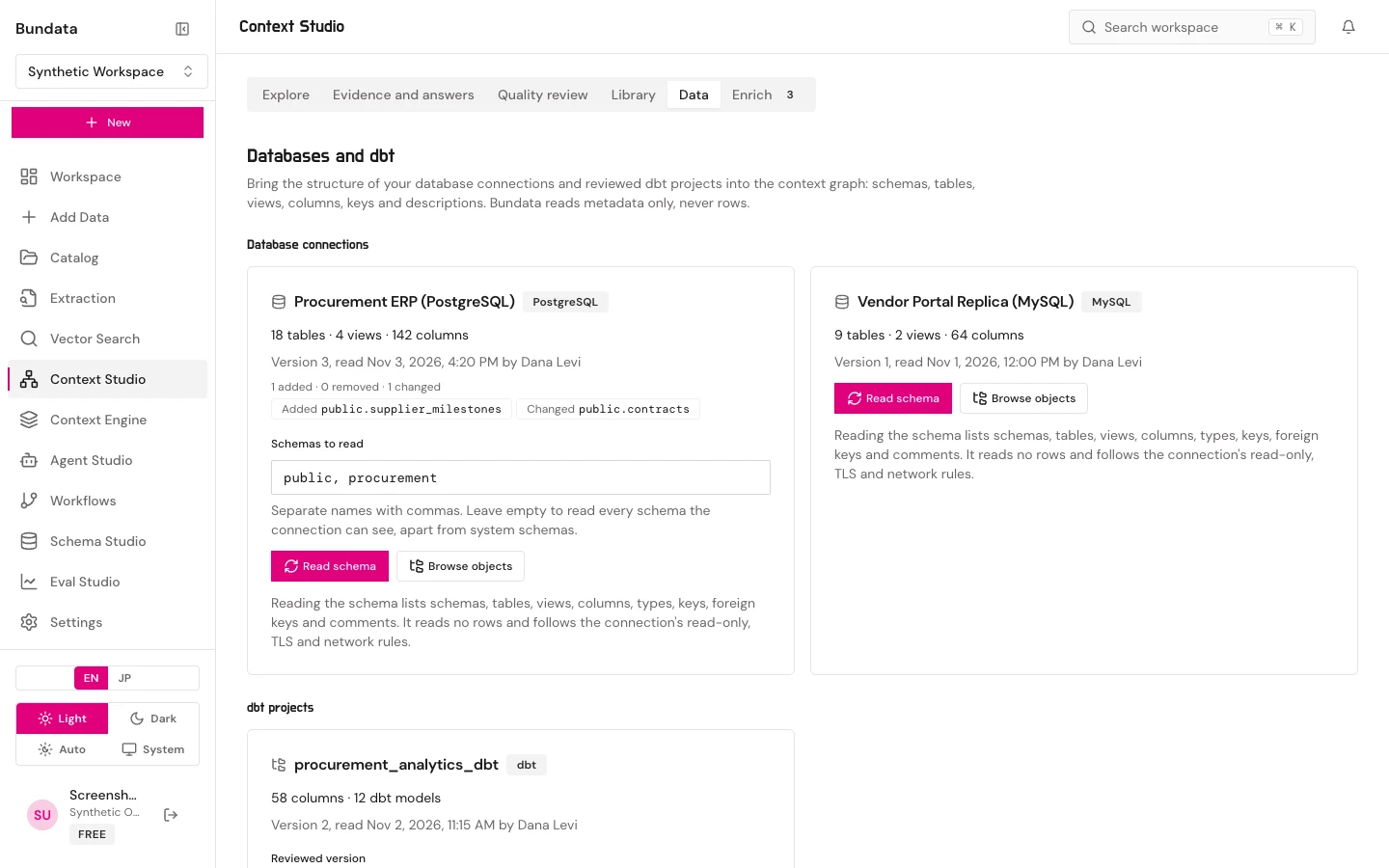
Context Studio’s Data tab (/platform/context-graph?view=data) brings the structure of PostgreSQL and MySQL source connections and reviewed dbt project versions into the context graph. Bundata reads metadata only during schema reads: no route, job, or record stores or logs table rows.
Reading database schemas and dbt bundles
- Read database schema (
POST /api/w/:wsId/structured-context/connections/:connectionId/read, requiresstructured:manageandconnection:use): Lists schemas, tables, views, materialized views, foreign tables, columns (types, nullability), primary/unique/foreign keys, and catalog comments frompg_catalogorinformation_schemawithin a 25-second and 16 MiB budget. Each read that detects a structural change stores a new immutable snapshot version (structured_snapshots) while preserving object identities so descriptions and term links stay attached. - Read dbt metadata (
POST /api/w/:wsId/structured-context/dbt/:executionVersionId/read, requiresstructured:manage): Reads models, columns, descriptions, declared types, tests, andref()dependencies directly from a reviewed dbt bundle without compiling or running dbt.
Curating objects and join paths
In Browse objects, editors with library:edit and connection:read can:
- Write a description (up to 2,000 characters) on any table, view, column, or dbt model.
- Link an approved business term from the library (
definesedge on the Explore canvas). - Record a join path (
joins_withedge) between two tables, views, or models in the same database where no foreign key is declared.
Context enrichment runs also draft Data description, Term to data link, and Join path proposals automatically from database comments, dbt docs, relationships tests, and <name>_id naming conventions without calling an AI model.
Read-only PostgreSQL query templates
Query templates are a fourth entry kind in the Business context library:
- Contract: One read-only
SELECTstatement bound to a single PostgreSQL source connection’s registered table, with optionalWHEREcomparisons to positional parameters ($1,$2, …),ORDER BY, andLIMIT. - Typed parameters and bounds: Parameters (
text,integer,numeric,boolean,uuid,date,timestamptz), a row limit (1–1,000), a time limit (1–30 s), and a hard server cap of1 MiBper result. - Test before approval: Editors run Test (
POST /api/w/:wsId/structured-context/templates/:entryId/test). A steward can approve a version only after a passing test at the connection’s current revision and with an assigned owner. - Where templates run:
- From the library entry sheet (Run).
- From Explore chat via
@sqlor the canvas node menu (Run this template). - As the query recipe attached to a verified answer (Run recipe, using the fixed parameter values stored in the answer).
- By agents via
run_query_template(MCP orPOST /api/agent/v1/query-templates/run, requiresqueries:runand membership in the active context set; agents pass parameter values only, never SQL).
Template runs execute in a READ ONLY transaction, re-check the connection every second, allow at most 4 concurrent runs per workspace (TEMPLATE_RUNS_BUSY), and record content-free run audit rows (query_template_runs) without ever storing or logging parameter values or returned rows.